

Projects NOW
Map of Projects
Each year, in consultation with our partners, Woman Cradle of Abundance chooses two or three major areas to develop. Some of these are long-term, others may be achieved in one year. Some projects are responses to problems our partners have encountered, such as devastating floods brought on by climate change or property destroyed in political violence. Other projects are part of our partners' development plans, such as purchasing a building or starting a new vocational school.
List of projects: Rebuilding FEBA's farm in Kinshasa province
Putting CCS Sewing Club (School) on a solid foundation in Goma
Houses for Rape-Flood Victims near Uvira
Rebuilding FEBA's Farm
BEFORE

BUT then came trouble.
The Problem: FEBA's large farm of about 66 acres was destroyed in the violence leading up to national elections in December 2023 and its aftermath in early 2024. The local chief and members of his family were assassinated, his village was burned, thousands of local villages became ghost towns as people fled to any place that seemed to offer safety. Loss of their farms has contributed to desperate hunger and high inflation for all food stuffs. And FEBA shared the suffering, having lost the major source on which it depends to distribute assistance to its food insecure members.

FEBA's farm situation: The remaining crops and equipment such as hoes and water containers were stolen, buildings were damaged or destroyed, chickens and ducks disappeared. To conclude the devastation, the miliary set fire to the region to smoke out the assassins and gangs, and destroyed FEBA's young orchard of fruit and moringa trees just when it was beginning to produce.
NOW
Beginning in 2024, FEBA has been working to restore the farm. Below shows the freshly cleared land waiting to be planted.

FEBA started with 12+ acres to plant mostly short-term crops like corn and vegetables which came to harvest early in 2025. See the beautiful corn which has helped to feed so many people!

After the corn appeared the staple cassava, a root crop, was added in between corn rows; cassava requires a year to mature. After the corn harvest, a little less than 15 acres was cleared and planting begun for more corn and vegetables. Cassava was also planted in the spaces. Now in 2026, another crop of corn has been harvested and the first cassava harvest has been completed, and regular plantings of corn and cassava are again providing food.

Above: the cassava tubers are peeled by hand. Below: the peeled tubers are soaked in water for several days to removed toxins, and then dried on racks in the sun. The soaking pool was ruined in the violence, so until it can be repaired, soaking is done in large plastic containers (the big blue object) before being exposed on the racks. Climate change has upset all the farming schedules. The rains have become so severe in rainy season that harvesting is often delayed (workers get mired in mud), and drying is further delayed, but they push forward.

Next Steps: Rebuilding and Expanding: Storage facilities and the soaking pool must be rebuilt, and the small animal husbandry project (ducks and chickens) must begin again from zero. A cistern to store water during dry season will be one of the next improvements. Then fruit trees can again be planted. Gradually all the land will be cleared again, but it is a very slow process.
Although FEBA tries to be a good neighbor, some of those around their farm who have not been able to restore their own production sometimes eye FEBA's crops and are tempted to help themselves, so a balancing act of courtesy to neighbors and protecting their own produce adds as degree of challenge.
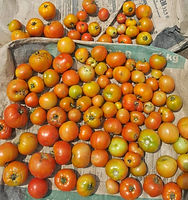

As a means to help support the program to feed food-insecure members, FEBA's farm has begun producing some 3-month crops like tomatoes, watermelon, cucumbers, and eggplant, which are popular in Kinshasa markets.
You Can Help!!!
Plant a fruit tree for $25
Buy corn seed for 1 acre for $50
Provide 15 chicks and 15 ducklings for $100
Build a chicken and duck house for $250
Contribute to a new storage building for $500
Sewing Club Rafiki for CCS
Community Charity School has a wonderful new sewing club, which will in due time become a vocational branch of the school.
Under the leadership of Mme. Anuarite Shabani, students and graduates of the CCS program and some displaced persons in the area are learning a trade. The youth can make their own uniforms and others to sell. The women can begin to clothe their families and have something to be the nucleus of a small business.
Club Rafiki presently has four machines, the most recent just purchased in July 2026. It needs four more, plus a supply of fabrics, thread, and other materials.

You Can Help!!!
Buy a length of uniform material for $25
Add 2 pieces of dress material for $50
Provide a manual sewing machine for $100
Give a treadle sewing machine for $250
New houses for flood victims
In December 2022-January 2023 floods devastated villages near Uvira, leaving hundreds of people camping in refugee shelters like schools or churches, month after month after month. A good start has been made in a cooperative effort to build back better. The villagers provide labor and local materials, while American partners help with things that need to be purchased, such as metal roofing.

Women seek stones for the building, carrying them on their heads. The stones are cemented into foundations, on which walls of sun-dried brick are raised. Metal roofing tops off the houses, and metal windows and doors with wooden frames are the final stage.

In 2023, thanks to generous friends, 20 houses were built. Again, in 2024, 20 more were built, in 2025, another 20 have constructed, and a number more (perhaps 12?) will be built before the end of 2026. Now 60 families are safe, but there are still over 80 who are making do with temporary shelters.
You Can Help!!!
Buy a window for $20
Add a sack of cement for $50
Provide 4 pieces of roofing for $100
Transport roofing from Uvira to the village for $250